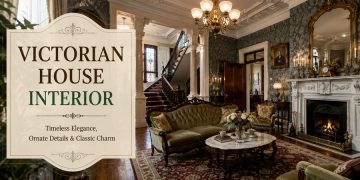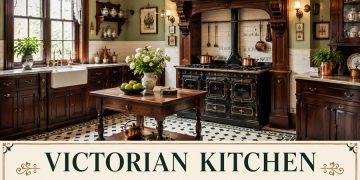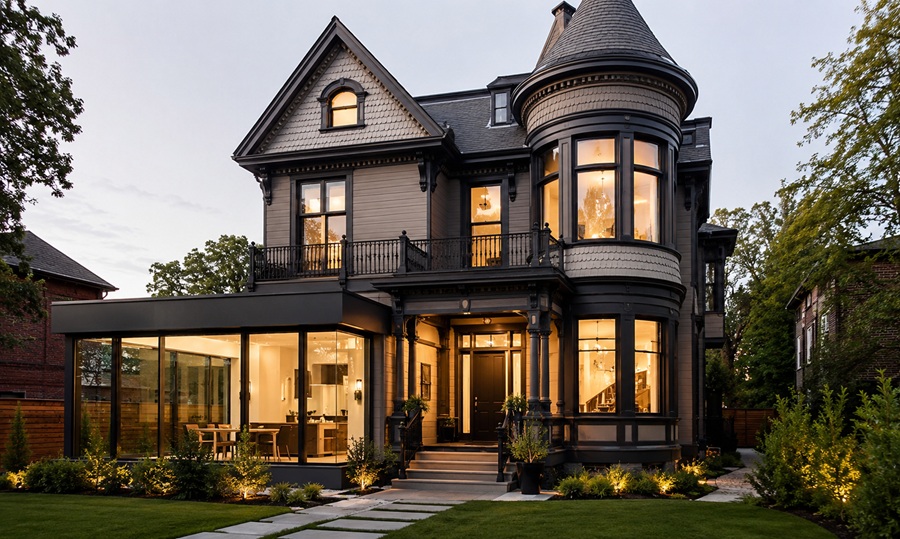
A visitor walking through a Victorian mansion for the first time usually stops at the same spot — the grand staircase — and asks the same question out loud: how did anyone afford to build this?
The short answer: the Gilded Age created enormous new fortunes in industry, and Victorian mansions were where that money went to be seen. These homes weren’t built quietly.
At a Glance
| Feature | Typical Detail |
| Era | 1860s–1900s |
| Common Sub-styles | Queen Anne, Second Empire, Romanesque Revival |
| Signature Exterior | Turrets, wraparound porches, asymmetrical massing |
| Signature Interior | Carved staircases, stained glass, pocket doors |
| Typical Owners | Industrialists, railroad magnates, merchants |
Architectural Hallmarks
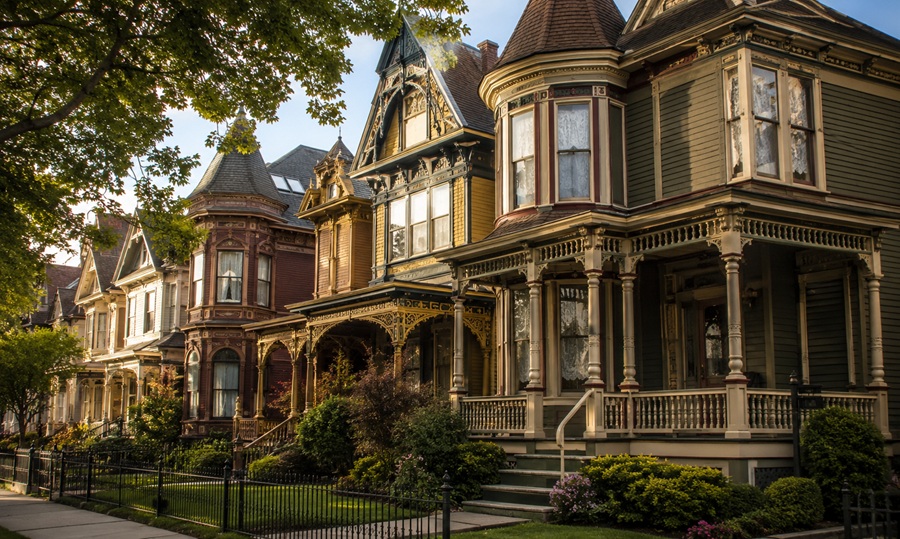
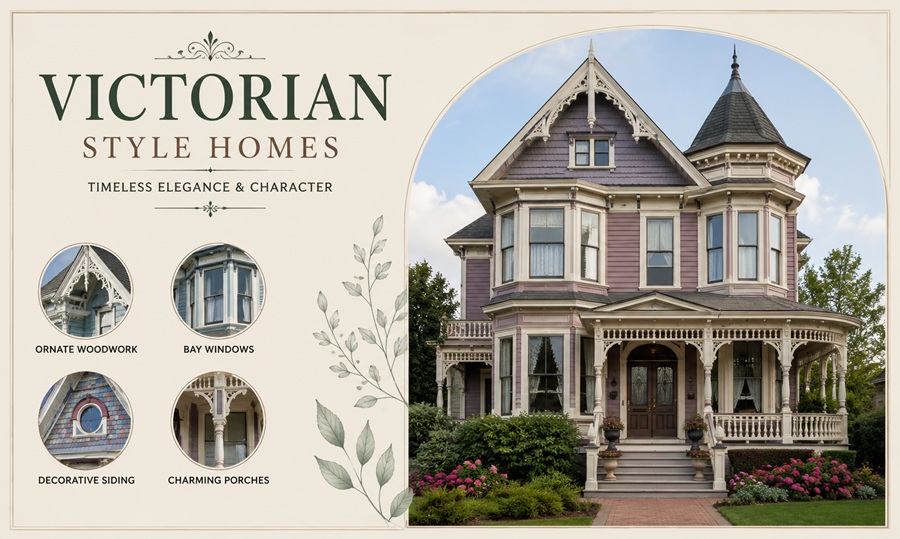
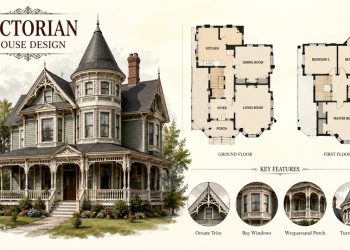
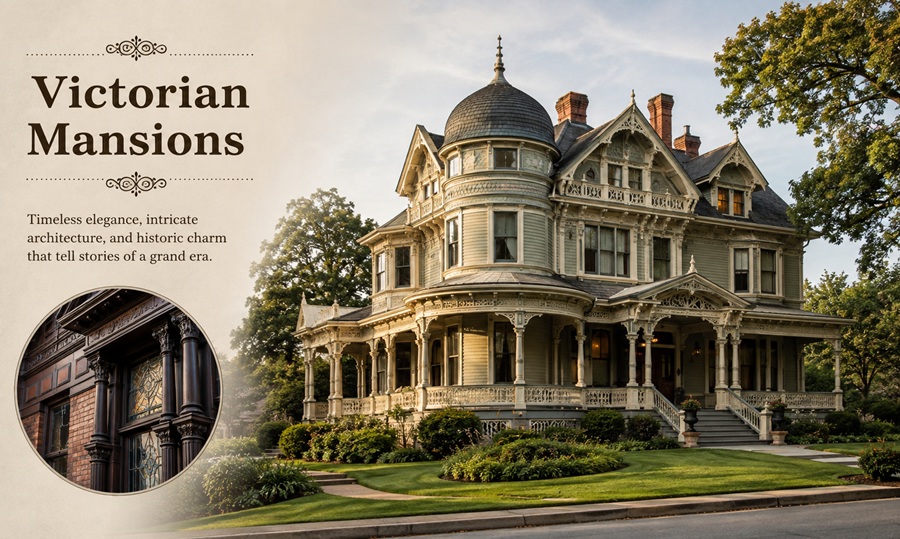
Victorian mansions weren’t built to one blueprint — they borrowed from several revival movements at once, which is part of why they can look so different from house to house. Still, a handful of features show up again and again:
- Turrets or towers breaking up the roofline
- Deep, wraparound porches with turned wood detailing
- Steeply pitched, multi-gabled roofs
- Bay and oriel windows projecting from the facade
- Decorative brackets under the eaves
- Patterned masonry or multi-textured siding
Interior Grandeur
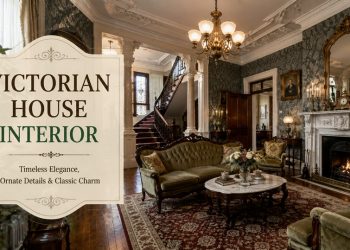
The Grand Staircase
Usually the architectural centerpiece of the entire house — carved newel posts, a landing large enough for a photograph, and often a stained-glass window positioned to catch afternoon light.
The Parlor and Receiving Rooms
Multiple formal sitting rooms were standard, each serving a slightly different social purpose — one for close family, one for formal callers.
Servant Areas
A defining but often overlooked feature: a completely separate set of stairways and passages allowed household staff to move through the home without being seen in the family’s living spaces.
Where These Homes Still Exist Today
Many surviving Victorian mansions have been converted into house museums, bed-and-breakfasts, or event venues, since the scale of upkeep is difficult for a single family to sustain today. Others remain private residences, quietly maintained by owners who’ve taken on the considerable cost of preserving original woodwork, plaster, and glass.
Preservation Challenges
- Original plumbing and electrical systems almost always need full replacement
- Slate or wood-shingle roofs require specialists, not general contractors
- Stained glass restoration is a specialized (and expensive) craft
- Heating a large, poorly insulated Victorian mansion efficiently is an ongoing challenge
- Exterior paint schemes require historical research to get period-accurate
The Grounds Mattered as Much as the House
A Victorian mansion was rarely judged on architecture alone — the surrounding grounds were part of the display. Formal gardens with geometric beds, carriage drives that curved for effect rather than efficiency, and often a conservatory or greenhouse for cultivating exotic plants were all standard for estates of any real size. Owners competed almost as fiercely over landscaping as they did over interior detail, since a well-kept, elaborate garden signaled the kind of sustained wealth that a single impressive purchase couldn’t.
How These Homes Functioned Socially
It’s worth remembering that a Victorian mansion wasn’t just a large house — it was a piece of social machinery. Formal calling hours, receiving rooms sorted by the visitor’s relationship to the family, and an entire second set of circulation paths for staff all reflect a rigid social structure baked directly into the architecture. Understanding that context makes the layout make more sense; the “excess” of rooms wasn’t excess at all from the owners’ point of view, it was infrastructure for a specific way of life.
FAQs
What’s the difference between a Victorian mansion and a regular Victorian house?
Scale and intent. Mansions were purpose-built to display wealth, with larger footprints, more elaborate detailing, and separate servant quarters — features a standard Victorian-era home wouldn’t have.
Are Victorian mansions expensive to maintain today?
Yes, significantly more than a comparably sized modern home, due to specialized materials, larger square footage, and aging systems.
Can you tour Victorian mansions?
Many are open to the public as museums or historic sites, particularly ones designated as landmarks.
What sub-styles fall under “Victorian mansion”?
Queen Anne, Second Empire, Romanesque Revival, and Stick style are among the most common umbrella categories.
Why do so many have turrets?
Turrets were largely decorative rather than functional — a way to add visual drama and asymmetry to the roofline, which was a hallmark of the era’s architectural taste.
Victorian mansions endure because they were never meant to be modest. Whatever their current use — museum, private home, event space — they remain some of the most photographed architecture in the country, and for good reason.