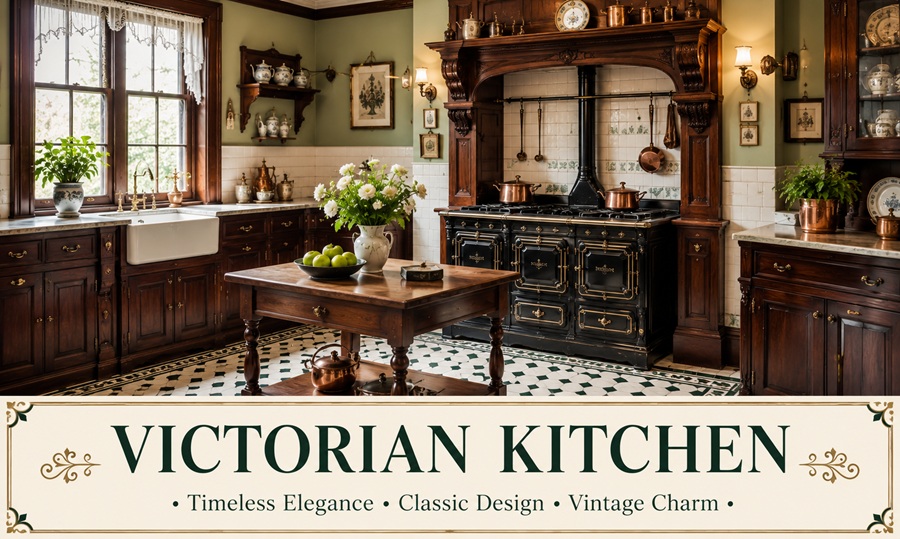
Picture a working kitchen from 1880: a cast iron stove, open shelving, a freestanding hutch, and absolutely no built-in cabinetry as we’d recognize it today. That’s the real starting point for Victorian kitchen design, and it’s worth knowing before you start picking finishes, because most of what people call a “Victorian kitchen” now is really a modern reinterpretation rather than a historical copy.
What Made Original Victorian Kitchens Different From Modern Kitchens?
During the Victorian era, roughly 1837 to 1901, kitchens were considered service spaces rather than showpieces. They were tucked toward the back of the house, often separated from the formal rooms, and staffed by servants in wealthier homes. Cast iron stoves, large farmhouse sinks, and open shelving were standard, and most storage came from freestanding pantries, hutches, and iceboxes rather than built-in cabinets. That history matters because a lot of what people now call “Victorian kitchen style” blends the era’s materials and detailing with the built-in convenience of a contemporary kitchen.
How Do You Choose Cabinetry for a Victorian Kitchen?
Victorian-inspired cabinets tend to have raised panel doors, beadboard detailing, and furniture-style legs rather than the flush, minimal look of modern cabinetry. Dark wood tones like mahogany, walnut, and cherry are common, though painted cabinets in deep colors such as forest green or navy also fit the era’s love of saturated color. Freestanding pieces help too. A large hutch, a plate rack, or a furniture-style island rather than a built-in one echoes the way Victorian kitchens actually stored and displayed items.
Which Materials Best Suit a Victorian Kitchen?
| Feature | Victorian-Appropriate Choice | Why It Works |
|---|---|---|
| Countertops | Marble, soapstone, or butcher block | All were genuinely used during the era |
| Flooring | Encaustic cement tile or hardwood | Patterned tile is one of the strongest visual cues |
| Backsplash | Subway tile with dark grout, or beadboard | Reads as period-appropriate without being overly ornate |
| Hardware | Oil-rubbed bronze, aged brass, matte black | Ornate detailing over sleek, minimal pulls |
| Sink | Apron-front farmhouse sink | Mirrors the large basin sinks common historically |
What Lighting Fits a Victorian Kitchen?
Victorian kitchens favor warm, ambient light over the bright, even lighting common in modern kitchens. Pendant lights with glass shades, wall sconces, and fixtures with brass or bronze finishes all support the era’s aesthetic. Layering light sources, rather than relying on a single overhead fixture, tends to look more authentic and also makes the kitchen more comfortable to actually cook in.
What Colors Work in a Victorian Kitchen?
Victorian interiors leaned into deep, saturated tones rather than the neutral palettes common in modern kitchens. Deep greens, burgundy, navy, and warm golds all suit the style. White or cream is also historically accurate, especially when paired with dark wood trim for contrast, and tends to work well in smaller kitchens where a very dark palette might feel heavy. A useful approach is to treat the cabinetry as the main color statement and keep the walls a complementary but slightly quieter tone.
How Do You Handle Modern Appliances in a Victorian-Style Kitchen?
Since modern appliances didn’t exist during the Victorian era, there’s no historically accurate way to include a refrigerator or dishwasher, so most homeowners take one of two approaches:
- Choosing appliances with a vintage-inspired look, such as retro-style ranges and refrigerators available from several major manufacturers
- Hiding standard appliances behind cabinet panels so they blend into the surrounding millwork
Either approach can look convincing. The right choice often comes down to budget, since panel-ready appliances typically cost more than their standard counterparts, and how much visual “quiet” you want from the appliances themselves.
What Are Common Mistakes When Designing a Victorian Kitchen?
Even well-intentioned Victorian kitchens can miss the mark for a few recurring reasons:
- Choosing cabinet hardware that’s too plain or modern, which flattens the whole look
- Skipping the tile floor pattern, since a plain floor makes the room feel unfinished
- Over-lighting the space with bright, cool-toned bulbs instead of warm light
- Mixing in too many contemporary materials, like glossy quartz or stainless steel, which can clash with the period details
- Opting for a fully open floor plan, since Victorian kitchens were enclosed rooms rather than part of an open-concept layout
How Do You Balance Authenticity With Modern Function?
Very few homeowners actually want a fully authentic Victorian kitchen, since that would mean no dishwasher, no refrigerator, and a layout built around servants rather than the person cooking. Most successful Victorian-style kitchens today blend the era’s materials and detailing with modern appliances hidden behind paneled fronts or tucked into a butler’s pantry. A practical starting point is to pick two or three signature elements, such as the cabinetry style, the tile pattern, and the lighting, and let those carry the Victorian character while keeping the rest of the kitchen straightforward.
What Should You Ask a Contractor Before Renovating a Victorian Kitchen?
If you’re working with an actual Victorian-era home, it’s worth consulting a contractor familiar with historic renovations, especially if the house is in a designated historic district, since some areas have specific rules about exterior and even interior changes. Useful questions include whether the existing plumbing and electrical can support modern appliances, whether any original architectural details in the kitchen are worth preserving, whether the property falls under historic district guidelines, and what a realistic timeline and budget range looks like given the home’s age and condition.
What Questions Come Up Most About Victorian Kitchens?
Homeowners planning this kind of update tend to run into the same handful of questions.
Do Victorian kitchens need an island?
Not necessarily. Islands weren’t a feature of original Victorian kitchens, so if you include one, a furniture-style island with turned legs will look more authentic than a built-in, flush-panel version.
What’s the easiest way to start a Victorian kitchen update on a budget?
Paint and hardware tend to offer the most visual change for the lowest cost. Repainting cabinets a deep, saturated color and swapping in ornate pulls or bin pulls can shift the whole feel of the room without a full renovation.
Can a Victorian kitchen have an open layout to an adjoining room?
It can, though it moves away from historical accuracy, since Victorian kitchens were closed-off service rooms. Many homeowners compromise by keeping a defined threshold, such as a wide doorway or a change in flooring, between the kitchen and an adjoining space.