The decision to DIY or hire out front-of-house landscaping usually comes down to three things: budget, time, and how complex the project actually is. Here’s how to figure out which side of that line you fall on.
DIY vs. Professional: A Comparison
| Factor | DIY | Hiring a Professional |
| Upfront Cost | Lower | Higher |
| Time Commitment | Higher (your own labor) | Lower (contracted timeline) |
| Design Expertise | Self-taught, trial and error | Professional planning included |
| Best For | Bed refreshes, planting, mulching | Grading, hardscape, drainage, tree removal |
| Risk of Costly Mistakes | Higher on structural work | Lower, covered by warranty/insurance |
A Step-by-Step Process (Whichever Route You Choose)
- Assess the site. Note sun exposure, drainage patterns, soil type, and existing mature plants worth keeping.
- Set a budget range before falling in love with any specific design.
- Sketch a rough layout — where beds, walkways, and focal points will go.
- Choose plants by zone and light conditions, not just by what looks good in photos.
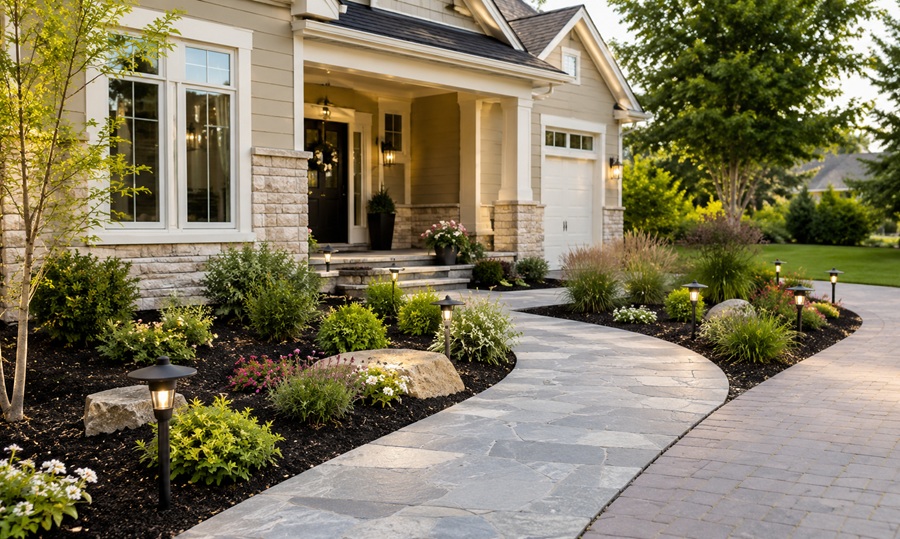
- Install hardscape elements first (paths, edging, structures) before planting around them.
- Plant largest elements first — trees and shrubs — then fill in with perennials and groundcover.
- Mulch everything to finish the look and protect new plantings.
Choosing Plants by Type
Foundation Shrubs
Planted directly against the house to soften the transition between structure and lawn. Choose varieties that won’t outgrow the space in a few years.
Ornamental Trees
A single well-placed tree can anchor the entire front yard composition — but consider mature size relative to power lines and the foundation.
Perennial Borders
Provide recurring seasonal color without annual replanting, though they require initial patience while establishing.
Groundcover
Fills gaps between larger plantings and reduces mulch needs over time once established.
When Hiring a Professional Makes More Sense
- Grading or drainage issues that affect the foundation
- Removing large trees or stumps
- Installing retaining walls or major hardscape
- Irrigation system design and installation
- Any project requiring permits
Typical Cost Ranges
| Project Type | DIY Cost | Professional Cost |
| Bed refresh + mulch | Low | Low–Moderate |
| New shrub/tree planting | Low–Moderate | Moderate |
| Walkway installation | Moderate | Moderate–High |
| Drainage correction | Not recommended DIY | High |
| Full front yard redesign | High (time) | High (cost) |
Vetting a Landscaping Contractor
If you decide to hire out any part of the project, a few questions separate a reliable contractor from a risky one. Ask for proof of liability insurance and, where applicable, a contractor’s license valid in your area — this protects you if something goes wrong on your property during the work. Request references from jobs completed at least a year earlier, not just recent work, since that’s the only way to see how the landscaping and any hardscape actually held up over time rather than how it looked on installation day. Get a written estimate that breaks out materials and labor separately, which makes it much easier to compare bids apples-to-apples.
FAQs
1. Is it cheaper to landscape the front yard myself?
Usually yes for planting and bed work, but structural projects like drainage or retaining walls often cost more in the long run if done incorrectly without professional help.
2. How long does a full front yard landscaping project take?
DIY timelines vary widely depending on available time, while professional crews typically complete comparable work in days to a few weeks.
3. Do I need a permit for front yard landscaping?
Generally not for planting, but retaining walls, drainage changes, or tree removal may require local permits — check with your municipality.
4. What’s the biggest DIY mistake homeowners make?
Skipping soil testing and light assessment, which leads to plants that struggle or die regardless of how well they’re arranged.
5. Should hardscape or planting come first?
Hardscape — paths, edging, structures — should generally be installed before final planting to avoid disturbing new plants during construction.
Front-of-house landscaping doesn’t have to be all-or-nothing between DIY and professional help. Many homeowners handle the planting themselves and bring in a professional only for the structural pieces — grading, drainage, hardscape — where mistakes are the most expensive to fix.