When you own or manage a commercial building, the roof is easy to ignore until the day it isn’t. A stained ceiling tile, a puddle that never drains, or a seam that opens after a hard freeze can interrupt operations and cost far more than planned maintenance ever would.
Flat and low-slope roofs work differently from the pitched shingle roofs on most houses. They rely on continuous membranes rather than overlapping pieces, so material choice and installation quality matter even more. Here is a plain-language comparison to help you prepare for the conversation with a contractor such as T&M Roofing, a Detroit company that installs and repairs TPO, EPDM and Duro-Last systems for offices, retail stores, warehouses and industrial buildings.
Why Flat Roofs Play by Different Rules
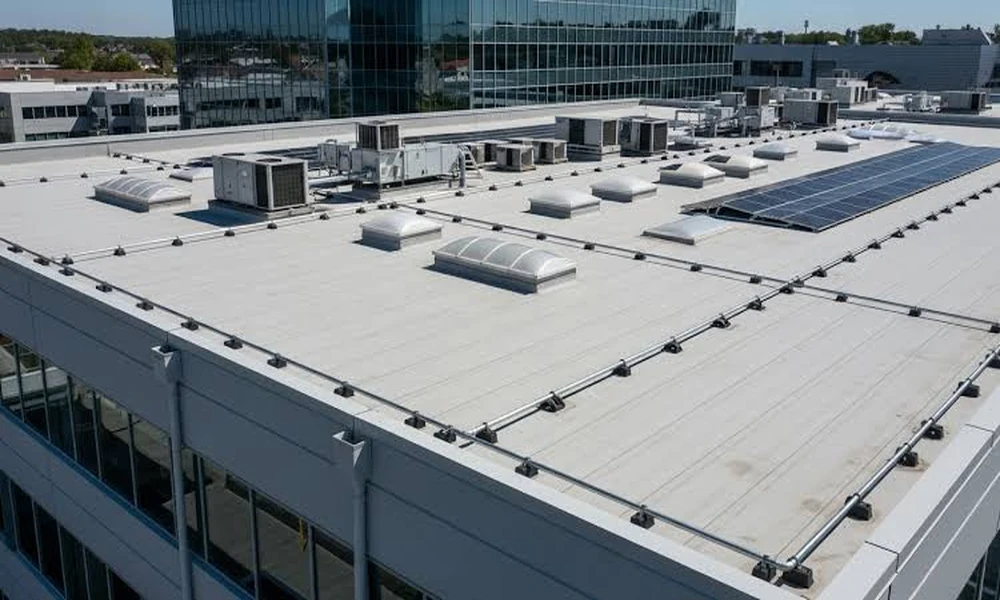
A flat roof is never perfectly flat. It is built with a slight slope so water can move toward drains, scuppers or gutters. When that drainage fails, water pools, and standing water puts constant stress on seams, flashing and the membrane itself. In Michigan, that water also freezes and thaws repeatedly through the winter.
That is why the best commercial roofing decisions start with three questions:
- How does water leave this roof?
- How does this building use energy through all four seasons?
- Who will maintain the roof, and how often?
The Contenders at a Glance
| TPO | EPDM | Duro-Last | |
|---|---|---|---|
| What it is | Single-ply thermoplastic membrane, usually white or light | Single-ply synthetic rubber membrane | Custom prefabricated single-ply membrane |
| Seams | Heat-welded | Typically adhered or taped | Factory-made sections, welded on site |
| Reflectivity | High, in light colors | Lower in standard black, with white options available | Available in light colors |
| Best known for | Energy-conscious buildings | Long track record and flexibility | Fit and precision, fewer field seams |
| Ask your roofer | Seam quality and warranty terms | Seam method and edge detail | Measuring process and lead time |
Treat this table as a conversation starter. The right choice depends on your building’s structure, insulation, drainage and budget, and a roofer who has walked the roof can tell you which fits.
The Energy Question: Cool Roofs in a Cold City
Many people assume reflective roofs only make sense in hot climates. Detroit summers are warm enough that cooling costs matter, but winters are long, so it is a fair question.
The EPA’s guide to cool roofs addresses this directly. It explains that cool roofs, which reflect more sunlight and shed more heat, can reduce air conditioning use and keep buildings more comfortable. They may raise heating use in winter in cold climates, but the page notes that this so-called heating penalty is typically offset by summer cooling savings. It also says good insulation and efficient design can reduce the penalty further, and that buildings with long-lasting snow cover see the lowest penalty because snow-covered roofs are already reflective.
Two more points from that page matter for owners of low-slope roofs. The EPA lists single-ply membranes with light or cool-colored pigments, along with reflective coatings, among the products used on flat commercial roofs. It also says low-slope cool roofs may need periodic cleaning to maintain their reflectance, which belongs in your maintenance plan.
Matching the Roof to the Building
| Building type | What to prioritize |
|---|---|
| Office or retail | Reliable drainage, a clean look, and energy performance for HVAC-heavy spaces |
| Warehouse or industrial | Large uninterrupted areas, durability under rooftop equipment traffic, and fast installation |
| Buildings with many rooftop units | Careful detailing around curbs, penetrations and flashing, where most leaks begin |
| Older buildings | A structural check and an insulation review before choosing the membrane |
Where Flat Roofs Actually Fail
Most membranes don’t fail in the middle of the roof. Problems tend to start in a few predictable places:
- Seams that open from movement or poor workmanship
- Flashing at walls, parapets and rooftop equipment
- Drains that clog with debris, causing ponding
- Punctures from foot traffic or dropped tools
- Insulation that has absorbed moisture and stopped performing
A roofer should inspect all of these, not just the visible leak.
A Simple Maintenance Rhythm
You can extend roof life with a basic schedule:
- Spring and fall: Clear drains and scuppers, check seams and flashing, and look for ponding.
- After storms: Inspect for punctures, lifted edges and debris.
- After any rooftop work: Have the area checked, since other trades can cause damage.
- Keep records: Photos, invoices and inspection notes help with warranty claims and insurance.
What to Ask Before You Sign
- Is the contractor licensed and insured? Ask for proof.
- Which manufacturers certify them as installers, and what warranty does that unlock?
- Will they inspect the roof deck and insulation before quoting?
- Is the quote itemized, covering membrane, insulation, flashing, drains and cleanup?
- What is the workmanship warranty, and what does it cover?
According to its website, T&M Roofing is family and veteran owned, has more than 20 years of experience, and is certified by Owens Corning, TAMKO and GAF. It also offers a 10-year labor warranty with a limited lifetime manufacturer warranty, and free written estimates at (313) 600-4538.
The Bottom Line
The best flat roof is not the trendiest material. It is the one matched to your building, your drainage and your maintenance habits. Ask good questions, get the details in writing, and treat the roof as an asset worth inspecting twice a year.